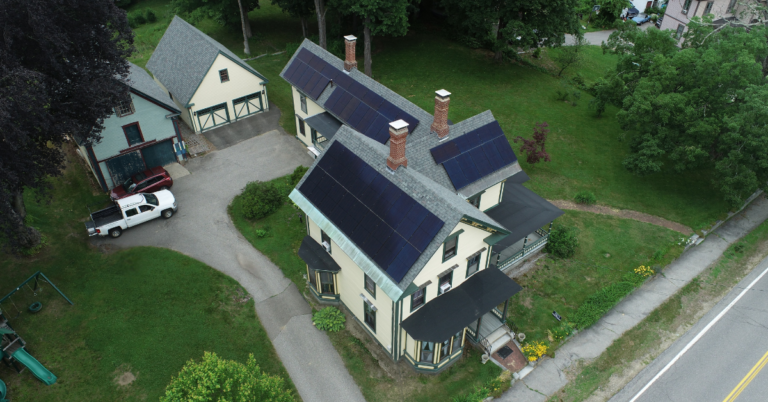

At almost every site visit, someone asks us a version of the same question: “So my electric bill goes to zero, right?” It could. Solar can completely eliminate your electric bill, and it typically makes it much smaller. Knowing how your bill works before you install helps you get the most from your system year-round.
The 4 Parts of a New Hampshire Electric Bill
Your monthly bill has 4 main charges. Solar panels reduce 3 of them.
Supply
Supply, also called energy service, is the cost of the electricity itself. It’s billed per kilowatt-hour (kWh). A kWh is the energy it takes to run 1,000 watts for 1 hour.
Transmission
Transmission covers moving power across the regional grid. It’s also billed per kWh.
Distribution
Distribution covers the local poles, wires, and substations that bring power to your house. Most of it is billed per kWh.
The Customer Charge
The customer charge is a flat monthly fee you pay no matter how much electricity you use. Eversource, Liberty, Unitil, and the New Hampshire Electric Cooperative each set their own amount, and you’ll find it listed on your bill.
Solar doesn’t change the customer charge, but the credits your system earns can help cover it.
How Net Metering Works in New Hampshire
When your solar panels produce more electricity than your house uses, the extra flows to the grid, and your utility credits it. This is called net metering.
How Your Credit Is Calculated
New Hampshire doesn’t credit exported power at the full retail rate. For each kWh you send to the grid, you get full credit for the supply and transmission charges and 25% credit for the distribution charge, according to Eversource.
A kWh your house uses the moment your solar panels produce it is worth more than a kWh you send to the grid. Running the dishwasher, doing laundry, or charging an electric vehicle (EV) during the day helps you use more of your own solar power directly. A home battery storage system can also hold daytime solar power for use in the evening.
Rolling Credits and Annual Payments
Credits carry forward from month to month. Eversource customers can request a payment once a year, after the March billing cycle, if their accumulated credit is more than $100.
Long-Term Credit Terms
Under current rules, systems enrolled in net metering keep this credit structure for the long term.
Competitive Suppliers and Community Power
The supply portion of your credit is the largest piece. If you buy your electricity from a competitive supplier or a community power program instead of your utility’s default service, that provider sets its own terms for the supply credit. Ask your supplier whether it participates in net metering, and check its terms before switching.
Average Electric Bill With Solar Panels: A New Hampshire Example
The average New Hampshire household used about 620 kWh a month and paid about $145 a month in 2024. Rates have risen since then, so today’s average bill is higher.
A well-sited solar array in New Hampshire typically produces about 1,200 kWh per year for every kilowatt (kW) of capacity. A kW is 1,000 watts. Here’s how an 8 kW residential solar system compares to average usage:
| Per Year | |
|---|---|
| Average household usage (620 kWh × 12) | About 7,440 kWh |
| 8 kW solar system production (8 × 1,200 kWh) | About 9,600 kWh |
| Annual surplus | About 2,160 kWh (about 29% more than the home uses) |
| Customer charge | Appears on every bill |
That system produces about 29% more electricity than the house uses over a full year. Here’s what affects how much of your bill it covers:
- The customer charge stays on your bill every month, though your credits can help cover it.
- Exported power earns a smaller credit. Every kWh sent to the grid earns only 25% of the distribution charge, so it’s worth less than a kWh your home uses directly.
- Summer surplus and winter demand don’t line up. Much of what your system exports in June is credited at that lower value and then spent covering your usage in December.
Your proposal should show an estimate built from your own bills.
What Changes Your Electric Bill After Solar
Adding New Electrical Loads
Any new electrical load, such as an EV, a heat pump, or new appliances, raises your usage. That typically improves your solar economics, because more of your production goes to use at home instead of earning the smaller export credit.
Switching Electricity Suppliers
Moving to a competitive supplier or community power program can change or remove the supply portion of your credit.
Tree Growth
Trees near your home can shade more of your solar panels as they grow, which gradually reduces production.
You Avoid Rising Electricity Rates
Every kWh your solar panels produce and your home uses is a kWh you don’t buy at the current rate. On August 1, 2026, Eversource’s residential supply rate rose from about 11 cents to about 14 cents per kWh. That’s nearly a 25% increase from a single rate change.
Solar reduces how much rate changes affect you. Our post on how solar protects against utility rate hikes explains more.
See What Your Electric Bill Would Look Like With Solar
Granite State Solar has been installing solar across New Hampshire since 2008, and our own in-house crews handle every installation. We back each project with a 12-year workmanship guarantee.
Every project starts with a free, no-pressure site visit, the first step in our solar installation process. We’ll look at your roof and shading, review your last 12 months of electric bills, and give you a production estimate based on your actual usage and your utility’s rates. You’ll see what your bill would look like in both July and January before you decide anything.
Sources
- Eversource. “New Hampshire Net Metering.” Accessed September 2026. https://www.eversource.com/residential/about/doing-business-with-us/interconnections/new-hampshire/new-hampshire-net-metering
- U.S. Energy Information Administration. Residential average monthly bill by state, 2024 (Table 5A). https://www.eia.gov/electricity/sales_revenue_price/pdf/table_5a.pdf
- Eversource. “New Hampshire Renewable Energy Certificates.” Accessed September 2026. https://www.eversource.com/residential/about/doing-business-with-us/interconnections/new-hampshire/renewable-energy-certificates
- Eversource. “New Hampshire Electric Supply Rates.” Accessed September 2026. https://www.eversource.com/residential/account-billing/manage-bill/about-your-bill/rates-tariffs/electric-supply-rates/nh