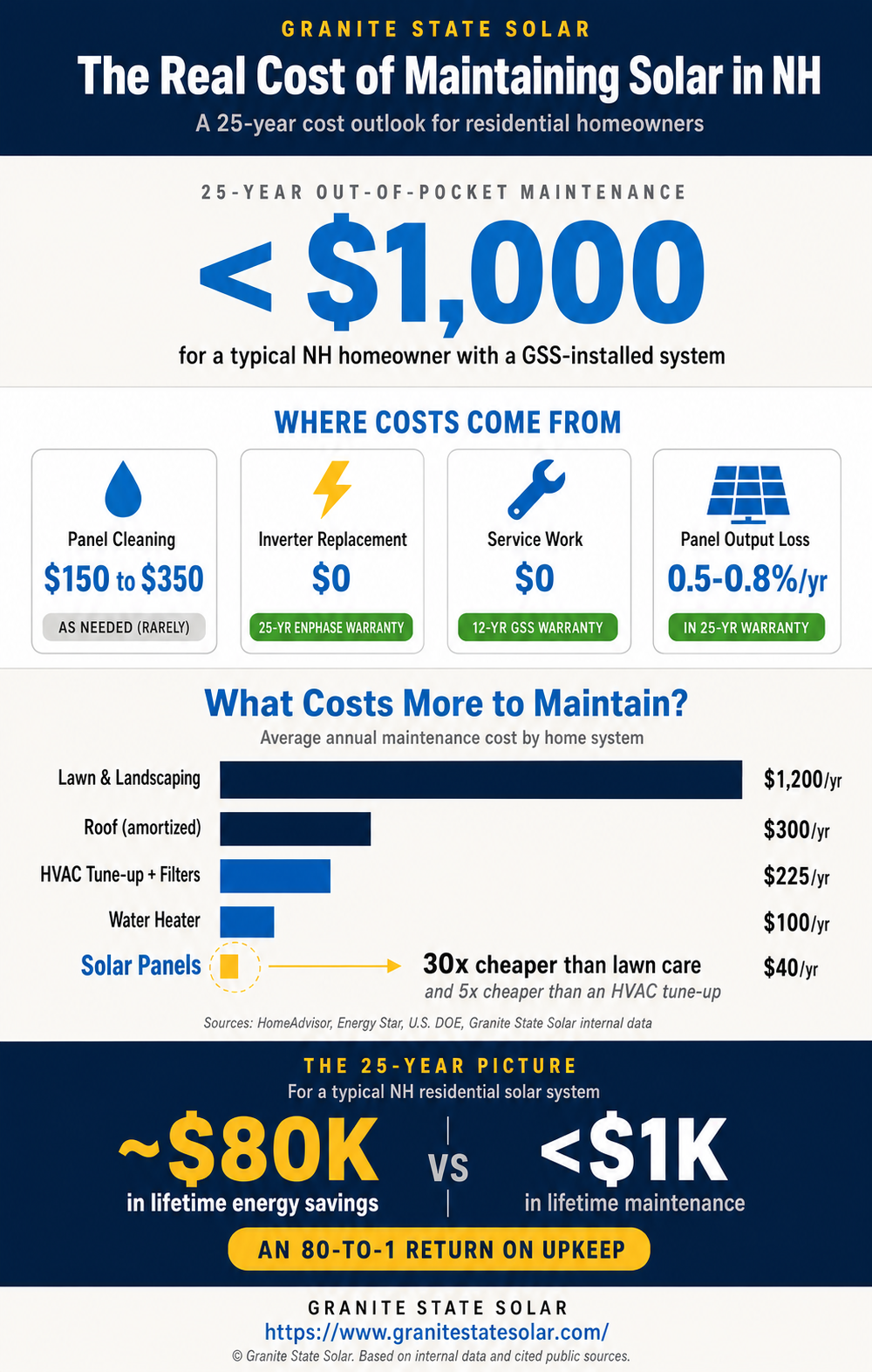
- Solar panel maintenance in New Hampshire is minimal: most homeowners spend less than a few hundred dollars across 25 years of ownership.
- Professional panel cleaning runs $150 to $350 per service, and most NH systems rarely need it because rain and snow shed debris on their own.
- Inverter replacement is the most likely larger expense at $2,000 to $5,000, and Enphase IQ8 microinverters carry a 25-year warranty that covers this for most current installs.
- A workmanship warranty from your installer covers service calls and labor – without one, repairs run $250 to $1,500.
Unlike many household appliances, solar systems require very little maintenance, which is one of their biggest advantages. Solar panels are built to withstand harsh New England weather conditions and are designed to naturally shed rain, snow, and debris. However, there are a few maintenance and replacement costs homeowners should be aware of over the 25+ year lifespan of a solar system.
Here’s what you can typically expect when owning a residential solar system in New Hampshire.
At-a-Glance: Lifetime Cost Categories
| Cost Category | Typical Range | Coverage |
|---|---|---|
| Panel cleaning | $150 to $350 | As needed (rarely) |
| Inverter replacement | $2,000 to $5,000 | Enphase 25-yr warranty |
| Service work | $250 to $1,500 | GSS 12-yr workmanship |
| Panel output loss | 0.5% to 0.8% / year | Built into 25-yr warranty |
Solar Panel Cleaning
In most cases, rain and wind naturally clean solar panels, so routine washing is usually unnecessary. If debris, pollen buildup, or heavy snow accumulation is impacting production, we do not recommend attempting to clean the panels yourself. This can be dangerous for both you and your system.
Instead, we recommend hiring a professional solar cleaning company. In NH, professional panel cleaning services typically cost between $150–$350 depending on the size and accessibility of your system.
For more on snow specifically, see our guide on how to get snow off your solar panels.
Inverter Replacement
The inverter is the part of your solar system that converts the electricity your panels produce into usable energy for your home. While inverter issues are uncommon, this is typically the component of a solar system most likely to need replacement over time. Luckily, the Enphase IQ8 Series Microinverters we install are backed by a 25-year manufacturer warranty.
If an inverter replacement is needed outside of the warranty period, homeowners can typically expect costs ranging from $2,000-5,000 including equipment and installation. The exact cost depends on the type of inverter system installed and the size of your solar array.
If you want the technical background on what an inverter actually does and why microinverters tend to last longer than string inverters, our introduction to inverters covers that in more detail.
Service Work for Your System
If your solar system requires service work, costs will depend on whether your installer provides a workmanship warranty. At Granite State Solar, our workmanship warranty covers your system for 12 years, helping protect homeowners from unexpected service expenses.
Without a workmanship warranty, service calls and repair work in NH can range from $250–$1,500 depending on the issue.
This is one of the reasons we always recommend getting multiple quotes and comparing warranty terms carefully. The sticker price of an installation is only part of the equation. What happens in year 8 or year 15 matters just as much.
What Happens to the Panels Themselves
The panels themselves are the most durable component of the system. According to degradation studies from the National Renewable Energy Laboratory, modern crystalline silicon panels lose roughly 0.5% to 0.8% of output per year on average. That means a system producing 10,000 kWh in year one is still producing around 8,500 to 9,000 kWh in year 25.
That gradual decline is the reason solar warranties are written in 25-year terms. Panels keep working long after they’ve paid for themselves. You can read more about what the full lifecycle of a solar panel looks like in our deeper dive.
The math, simplified: a 10,000 kWh system at NH residential rates of around $0.25/kWh produces roughly $2,500 in annual savings. Even at the high end of maintenance projections, a homeowner spends less than 0.5% of their lifetime solar savings on upkeep.
The Bottom Line
Solar systems are designed to be low-maintenance and long-lasting. While there may be occasional costs over the life of the system, they are typically minimal compared to the long-term savings solar provides.
Choosing an installer that offers high-quality equipment, strong warranties, and dependable service can make a major difference in keeping ownership costs low over the years.
Frequently Asked Questions
How often do solar panels need cleaning in New Hampshire?
For most NH homeowners, never on a scheduled basis. Rain and snow handle the cleaning, and roof-pitched arrays shed debris on their own. If you notice a drop in production through your monitoring app that doesn’t match the weather, that’s the signal to call in a professional cleaning service.
Can I clean my solar panels myself?
We don’t recommend it. Climbing onto a roof is dangerous, and using the wrong cleaning method can damage the anti-reflective coating on the panels. If cleaning is truly needed, hire a professional. The $150 to $350 cost is small compared to the risk.
What does the Enphase IQ8 25-year warranty cover?
The Enphase IQ8 microinverter warranty covers manufacturer defects and failures for 25 years from the date of installation. If a microinverter fails within that window, Enphase replaces the unit. Labor to swap a covered unit is typically covered by your installer’s workmanship warranty during its term.
Does GSS monitor my system after installation?
Yes. Enphase systems include a monitoring app that shows production at the microinverter level, and the GSS service team uses the same data to flag underperforming panels remotely. Many minor issues get caught and resolved before homeowners would even notice. Our process page walks through what happens after installation.
Will maintenance costs affect the resale value of my solar home?
Buyers tend to view a transferable manufacturer warranty as a positive, and a documented service history makes resale conversations easier. Most studies show solar adds to home value rather than subtracts from it, and long-term maintenance cost is rarely a sticking point in a sale.
Are there any annual maintenance fees I should plan for?
Not with GSS. There’s no required annual service plan or recurring fee for a residential solar system installed by us. Across 25 years of ownership, the realistic maintenance budget for a typical NH homeowner is well under $1,000 and often closer to zero thanks to warranty coverage.
Get a Quote with Warranties That Hold Up
Maintenance costs over the life of a solar system come down to two things: the quality of the equipment and the installer’s commitment to standing behind it. Granite State Solar pairs Enphase microinverters with a 12-year workmanship warranty, so the bulk of long-term cost risk is already covered before you sign.
Request a Free Quote